
When a weighted decision matrix changes its winner
Recalculate a fictional procurement ranking reversal, check budget limits and comparable scores, and record tradeoffs and unresolved conditions.
On this page
A decision matrix ranks options under stated scores and weights. In this fictional procurement exercise, increasing quality from 40% to 60% while keeping speed and cost equally weighted changes the leader from A to B; the options tie at 50%. That threshold belongs to these scores, rather than being a recommended quality weight for every decision.
Apply the hard budget limit first, then check scoring evidence and sensitivity. Leave with a record of constraints, tradeoffs, and unresolved checks, rather than a procurement choice based only on the highest total.
“A has the highest score, so choose A” leaves out the budget check and whether other reasonable weights change the ranking. A useful record explains which options are feasible, what tradeoff drives the ranking, and what remains unresolved.
Apply hard limits before scoring
Fictional example: a team is choosing a provider for a design project with a budget cap of CNY 20,000. All prices and scores are invented for this exercise. They are not market quotes. Amounts remain in Chinese yuan (CNY).
| Option | Quoted price | Quality score | Delivery speed score | Cost score |
|---|---|---|---|---|
| A | CNY 12,000 | 3 | 5 | 5 |
| B | CNY 18,000 | 5 | 3 | 3 |
| C | CNY 26,000 | 5 | 5 | 1 |
Each score runs from 1 to 5, with higher scores always more favorable. Quality is assessed using the same trial task: 3 means the mandatory requirements are met but revisions are needed; 5 means both the mandatory requirements and the additional requirements agreed in advance are met. Speed reflects whether delivery fits the team's desired window. Cost scores use price bands agreed in advance; they are not the quoted amounts themselves.
These bands still involve judgment. Keep the scoring criteria and trial records. Turning a judgment into a number does not make it an objective measurement.
C is over budget. Exclude it or renegotiate its price before comparing scores. If the budget is a hard cap, better quality and faster delivery cannot compensate for exceeding it. Treating the budget only as a lightly weighted criterion can produce a winner the team cannot actually choose.
The same scores can produce different rankings
Compare the feasible options, A and B. Start with quality at 40%, speed at 30%, and cost at 30%. Multiply each score by its weight, then add the results.
| Option | Calculation | Weighted score |
|---|---|---|
| A | 3 × 0.4 + 5 × 0.3 + 5 × 0.3 | 4.2 |
| B | 5 × 0.4 + 3 × 0.3 + 3 × 0.3 | 3.8 |
Now give quality a weight of 60%, with speed and cost at 20% each. A falls to 3.8 and B rises to 4.2. None of the individual scores changed, but the ranking reversed.
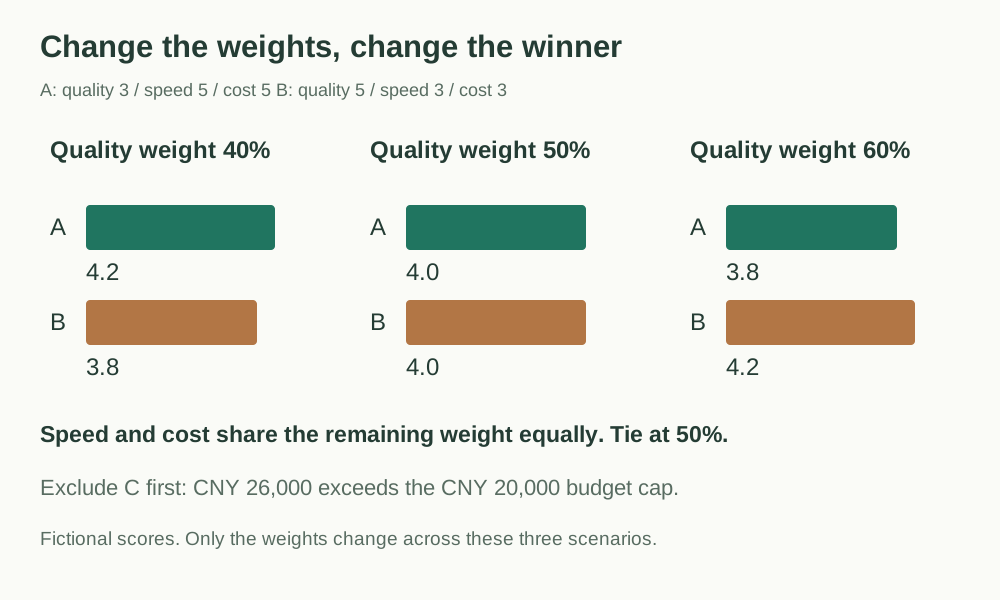
To find the tipping point, keep speed and cost equally weighted. If the quality weight is w, the other two weights are each (1 − w) ÷ 2. A's total is 5 − 2w; B's is 3 + 2w. At a quality weight of 50%, both score 4.
The 50% threshold follows from this example's scores. It is not a general rule for other decisions. If you stop weighting speed and cost equally, recalculate with the new weights.
Try changing the quality weight
Speed and cost share the remaining weight equally. The scores for A and B stay the same.
Speed and cost each receive 30%. Total weight remains 100%.
At 40%, A leads 4.2 to 3.8. At 60%, B leads 4.2 to 3.8. The reversal shows a tradeoff to discuss; it does not select a provider. These fictional scores and the equal speed/cost split determine this example's 50% tipping point.
Use the reversal to guide the discussion
If the team considers any quality weight from 40% to 60% reasonable, the current ranking is not stable. The next discussion should address whether the additional quality requirements justify extra cost and waiting time. A slide showing only the winner's 4.2 would hide that question.
Check the scores as well. If B received a 5 for quality based on promotional material while A received a 3 based on an actual trial, the evidence is not comparable. Ask both providers to complete the same small task, or use a plausible range of scores and check whether the uncertainty changes the outcome.
Watch for double counting. If “quality,” “less rework,” and “acceptance rate” all come from the same trial measure but each receives a high weight, the same advantage is being counted several times.
Leave a decision record you can explain
When using the Decision matrix, record hard limits first. Then agree on criteria, weights, and scoring evidence. Finally, check whether the same option leads across a reasonable range of changes.
Hard limits: Which requirements must be met?
Scoring criteria: What does each score mean?
Weighting rationale: Why do these tradeoffs fit the current goal?
Sensitivity: Which changes would reverse the ranking?
Decision: What will you choose, which tradeoffs will you accept, and what still needs checking?
Use the practice data to set quality to 40%, 50%, and 60%, keeping total weight at 100%. You should see A lead, then a tie, then B lead. That completes a first sensitivity check. Discuss the weights and evidence before making the decision.
An initial record could read: “C exceeds the current hard budget. A and B change places within the disputed 40%–60% quality range. The choice remains open until we explain the value of the additional requirements and check both scores against the same trial task.” The actual team should name the owner and review date. If it chooses under one set of weights, retain the accepted tradeoffs and conditions that would reopen the decision.
Review a comparison with AI
Paste an existing option comparison into your usual AI assistant. Use it to expose missing evidence and disputed assumptions, then verify the calculations and records.
Review these options using only the supplied material.
Separate hard constraints from weighted preferences. Mark missing evidence as
unknown; do not invent scores or weights. Check that higher scores consistently
mean better outcomes and identify criteria that may count the same evidence twice.
For the weights I supply, show the calculation and which reasonable changes
could reverse the ranking. If I supplied no alternative weights, ask for them.
Summarize the tradeoff and open questions without selecting an option for me.
My options, evidence, scores, and weights:
[paste material]