
After SWOT: turn an idea into a testable action
Trace an action to its conditions, then retain assumptions, a test, effort limits, and stopping conditions in a small plan you can review.
On this page
After SWOT, turn specific conditions into an action you can test. TOWS connects internal conditions with external opportunities or threats to propose candidates, then checks what an action depends on and what would justify continuing.
Start with the output this case can support:
Contact the 5 organizations that asked about a paid pilot. Check upcoming events, decision makers, current practices, and integration needs before discussing one standard setup pilot. Cap new work at six person-days. Pause for review if there is no specific commitment, no reason to switch, or a requirement to expand integration. Owner, schedule, and approval remain unconfirmed.
Use the same fictional material to trace this plan, explore the other candidates, and adapt a complete plan of your own. A pilot inquiry is not an order, and a plan is not a validated strategy. If your SWOT only says “a professional team” and “a large market,” gather evidence first.
Use one goal to select relevant conditions
Fictional example: a two-person team provides a workshop registration tool. Over the next two weeks, it wants to test whether serving more small training providers is worth pursuing. The team has 10 person-days available, of which 4 are committed to supporting current customers. New experiments can use no more than 6 person-days.
| ID | Condition | Evidence and limits in this example |
|---|---|---|
| S1 — strength | Existing users can repeat the core workflow | Of 8 trial organizations, 6 used it twice within four weeks. The sample is small. |
| S2 — strength | Standard setups are relatively quick | Of 8 setups, 7 were completed within one week. This applies only to standard setups. |
| W1 — weakness | Limited capacity for complex integration | The tool has not been connected to customers' finance systems. |
| W2 — weakness | Limited capacity for new work | Only 6 person-days remain for testing over the two weeks. |
| O1 — possible opportunity | Similar organizations have asked about related needs | In 12 interviews, 5 organizations asked about a paid pilot. None of these inquiries is an order. |
| T1 — threat | Standard alternatives exist | In this fictional case, a competitor already offers basic registration features. Its pricing and customers' willingness to switch remain unverified. |
Classify internal and external conditions relative to the team you are analyzing. The team can change its integration capability, so that belongs under weaknesses. It cannot decide whether customers want to buy, so the interviews provide a possible external opportunity that still needs testing.
The eight trial organizations, eight setups, and twelve interviews are different observation units; the case does not establish whether they overlap. Do not combine them into an overall success rate or infer that six repeat users prove the five pilot inquirers will buy. Each condition supports only its stated scope.
Check what T1 actually replaces. Matching registration features do not establish that organizers' setup, handoff, and repeat-event tasks are all covered. Ask how customers handled their most recent event, which step remains unresolved, and why they are considering a change. If their current approach is sufficient, faster setup may not justify switching. This case has no such records, so the intended difference still needs testing.
Turn combinations into specific actions
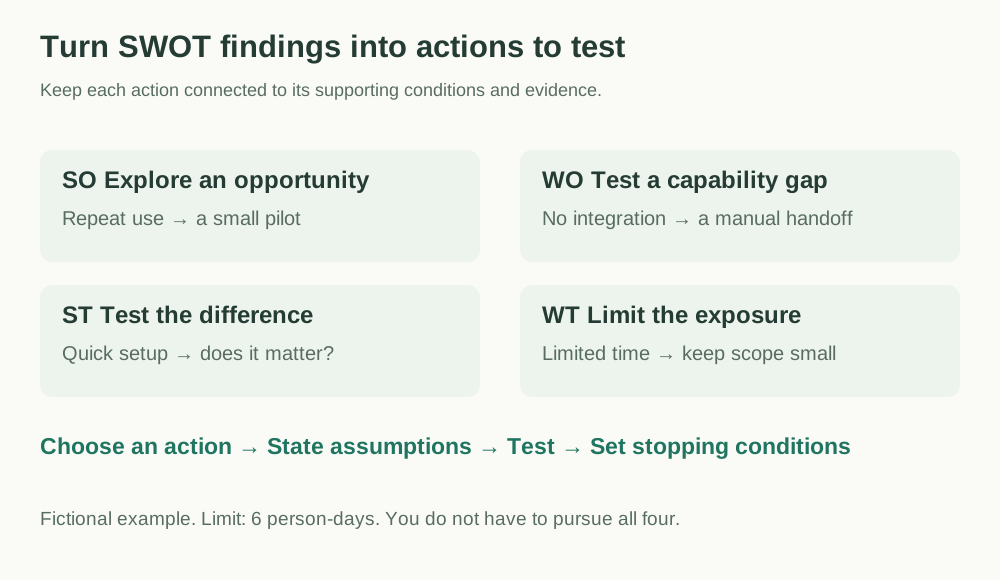
Ask how a strength might help you pursue an opportunity, how an opportunity might help you address a weakness, how a strength might help you respond to a threat, and where weaknesses and threats together justify limiting your effort.
| Combination | Candidate action | Key assumption |
|---|---|---|
| S1 + O1 | Show the repeat-use workflow to interviewees with a clear need and invite them to a limited pilot. | They will commit to actual use, rather than just express interest. |
| W1 + O1 | Test the finance handoff using exported files and a manual process first. | Customers can accept this temporary arrangement. Do not describe it as a completed integration. |
| S2 + T1 | Compare the customer's current approach with the standard setup for the same event task, then test whether ease of deployment matters. | The customer has an unmet task and values this difference enough to choose the product. |
| W2 + T1 | Exclude opportunities that need complex integration for now and cap this round's effort. | The team accepts passing up some opportunities in the short term. |
These are candidate strategies. Filling all four cells does not mean you should carry out all four. Different combinations may produce similar actions that can be merged. Leave a combination empty if it does not suggest a meaningful action.
Make one candidate small enough to test
The team could begin with a narrowly scoped pilot. Contact the 5 organizations that asked about a paid pilot. Check who has an upcoming event, who can make the decision, and whether complex integration is required. Continue the pilot discussion only when the needs and conditions fit.
Allow 1 person-day for qualification and requirements, up to 3 for one standard setup pilot, 1 to observe use, and 1 in reserve for problems. The total stays within 6 person-days. This allocation belongs to the example; it is not a standard project estimate.
Set stopping conditions before starting. Do not pursue a pilot with an organization whose current approach meets its need and gives it no reason to switch. If no organization commits to using the tool for a specific event, return to investigating needs. If finance integration is required before anyone will try it, estimate the work again. Do not quietly expand the scope within the existing budget.
There is a gap between “customers asked about a paid pilot” and “customers will buy.” TOWS helps you propose an action. A test helps you assess whether that action is worth pursuing.
Trace one action to its conditions and test
These controls explore the article's fictional candidates. Selection does not recommend, approve, or carry out an action, or fill your personal draft.
Test commitment to use it for a specific event
- Supporting conditions
- S1 6 of 8 trial organizations used it twice in four weeks; a small sample.
- O1 5 of 12 interviewees asked about a paid pilot; there are no orders.
- Assumption still to test
Interview interest will become a commitment to use it for a dated event.
- Proposed test
Contact the 5 pilot inquirers. Check upcoming events, decision makers, current practices, and integration requirements before discussing one standard setup pilot.
- Effort and stopping conditions
Return to investigating needs if there is no specific commitment or the current approach is sufficient with no reason to switch.
New work is capped at six person-days. The SO pilot uses 1 + up to 3 + 1 + 1; other candidates need separate estimates. Owner, approval, and review date remain unconfirmed.
Write one action for your own work
Paste or adapt a complete plan. Changing the example above does not change your personal text here.
Personal plans are saved separately by language in this browser. Review again after editing. Clearing site data deletes drafts; keep a downloaded copy.
Keep each action connected to its evidence
Organize the conditions with SWOT analysis, then use the combinations above to explore actions. The TOWS matrix guide provides an editable example. Attach the relevant condition IDs to each candidate so you can trace its reasoning later.
Candidate action: What will you do?
Supporting conditions: Which strengths, weaknesses, opportunities, or threats support it?
Alternatives: How does the customer currently do the work, what remains unmet, and why consider switching?
Key assumption: What has not yet been confirmed?
Test: How will you get the evidence needed to decide?
Effort and stopping conditions: What is the resource limit, and when should you change course?
If an input changes—for example, customers no longer need a short pilot—the condition IDs help you find the affected actions. That makes revision easier than keeping only a statement such as “expand marketing.”
If several candidates compete for the same resources, first exclude those outside the effort or capability limits. Then use the decision matrix sensitivity checks with feasible candidates, scoring evidence, and explicit tradeoffs. The output is a choice record you can explain; that article's fictional procurement prices and scores are not evidence about this pilot.
Check the offer before expanding promotion
If a candidate action changes the offer or how it reaches customers, use the 4Ps marketing mix to review product, price, purchase and delivery channels, and promotion together. For this registration-tool pilot, clarify what is included, the pricing conditions, the manual delivery arrangement, and the message about standard setup. Prices and demand remain unknown where this case provides none; a coordinated offer still needs a test within the six-person-day limit.
The guide's CNY 29 breakfast-pack case is a separate fictional exercise. It illustrates matching booking, pickup, and communications, without adding sales results or pricing evidence to this article. The four Ps are offer categories, not ranked quadrants or proof that promotion will work.
Practice data: SWOT evidence, capacity, and stopping conditions.
For an AI-assisted review, provide the original conditions, evidence limits, candidate action, and effort cap. Ask for unsupported connections, untested assumptions, and missing stopping conditions. Do not require all four combinations to be filled, or treat generated customer intentions or approval status as facts.