
Describe work achievements with clear ownership and evidence
Select a statement from your summary to check ownership, deliverables and evidence, retaining the original text and unknown impact.
On this page
Describe the goal, your role, the output, the evidence supporting the result, and what remains unknown. Activity records can provide material, but activity counts, team results, and individual contribution are different things. You do not need to turn every deliverable into a revenue or efficiency claim.
This exercise provides a complete achievement statement and a contribution-and-evidence table. Explore individual, team, deliverable, and impact scopes, then paste your own summary and select a statement to check its ownership, evidence status, and missing material. It can support a period review or self-assessment. Clear expression does not establish promotion eligibility or guarantee recognition.
Keep a separate record of individual contribution
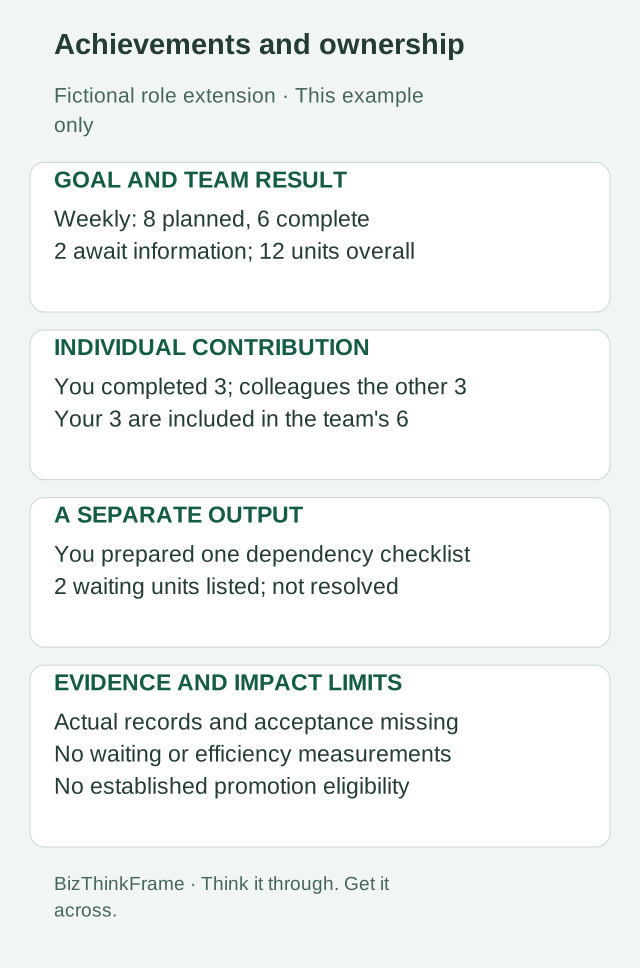
Original fictional teaching material: the configuration project has eight planned units this week, six complete, two awaiting interface information, and 12 overall. This article alone adds a fictional role: the person reporting independently completed three of the six units and prepared one dependency checklist; colleagues completed the other three. The checklist identifies two units awaiting information. Listing them does not establish that the information has arrived. These role details do not revise the other examples.
There are no actual acceptance records, feedback, or business-benefit measurements. “Complete” is a progress status given in the teaching material, not evidence of customer acceptance. If your organization defines completion by acceptance, state that definition and provide the relevant record.
| Layer | Fictional material | How to describe it |
|---|---|---|
| Goal | Complete eight weekly units by the agreed check-in | Retain the target, timing, and unfinished portion |
| Individual work | Independently completed three; prepared one dependency checklist | Name your scope and output; a checklist is not another configuration unit |
| Team delivery | Six complete in total; colleagues completed the other three | State collaboration; your three are included in the team's six |
| Evidence | Real work would use task records, delivery versions, acceptance status, and the checklist | This exercise supplies fictional material, not real links or feedback |
| Impact limits | No waiting-time, revenue, or efficiency measurements | Business effects remain open; do not claim a significant efficiency improvement |
Your three plus colleagues' three make the team's six. Adding your three to the team total would incorrectly claim nine. Nor does 3/6 mean you created 50% of the business value: units can differ in complexity, support, and value.
A complete achievement statement
The weekly goal was to complete eight configuration units by the agreed check-in. The team completed six: I independently completed three and colleagues completed the other three. I also prepared one interface dependency checklist identifying two units awaiting information. My completed units are included in the team total; the checklist is a separate document output.
Two planned units remain incomplete. The exact Friday demo impact and full causes are still open. Current material establishes delivery scope and dependency documentation, not shorter customer waiting, improved efficiency, or sole personal ownership of the team's result. In a real report, I would add task records, delivery versions, acceptance status, and the checklist location.
I propose confirming information contacts and availability, and checking whether relevant members can use the checklist. Ownership, dates, effort, and approval need agreement. Checklist effectiveness has not been measured.
The statement makes your work visible without taking credit for everyone else's. If your actual role was coordination, review, or coaching, describe that role and its evidence rather than claiming independent delivery. When counts are not comparable, use the deliverable's purpose, problem-solving process, quality status, and the actual scope of user feedback.
Match each contribution to its evidence
Explore four scopes in the fictional achievement statement, then check one sentence from your own summary.
I independently completed 3 configuration units.
Use individual task records and delivery versions; this case has no real acceptance record. Describe coordination, review, or coaching as the actual role.
The personal three are included in the team's six, not added to them. 3/6 is not a share of business value.
Paste your complete summary
No statement selected. Select again after editing the original.
Editing the original resets the selection and labels while retaining evidence notes. The site does not infer roles, verify facts, or rewrite your text.
Review the complete record
Personal achievement statement; ownership and evidence are labeled by you, not verified by this site

Full original statement:

Period, goal and completion definition:
Actual personal role, actions and scope:
Team result and colleagues' contributions:
Relationship between individual and team outputs:
Evidence locations, versions, acceptance and feedback scope:
Unfinished work and unknowns:
Actually observed impact:
Unsupported value or causal claims:
Reusable learning, conditions and limits:
Next check, owner, date and time, and approval:

Statement selected this time:

No valid text selected

Scope labeled by you: Scope unconfirmed

Evidence status labeled by you: Evidence needed

Evidence and gaps for the full statement:


Review checks this time: 0/3

Retain team and individual boundaries. Check work records, acceptance, feedback, and impact measurements separately. Where counts are not comparable, describe the role, deliverable, and scope of feedback.
Personal material is saved separately by language in this browser. It is not uploaded or translated. Clearing site data deletes it; keep a downloaded copy and avoid editing it in multiple tabs. Review checks reset after changes.
Repair three common statements
| Draft | Problem | Revision supported by this example |
|---|---|---|
| “I did a lot of configuration work” | Role, output, and target are unclear | “Of eight weekly units planned, I completed three independently; the team completed six” |
| “I delivered the team's six units and transformed efficiency” | Claims sole ownership and unsupported impact | “I completed three and prepared a dependency checklist; the team completed six. Efficiency change is unmeasured” |
| “The checklist means we will never be late again” | A document becomes a guaranteed effect | “The checklist identifies two units awaiting information; usability and delivery effects need follow-up” |
With real feedback, record who said what, when, about which output, and within what scope. One person's positive comment does not represent all teams or establish a fixed time saving. Use evidence in ways permitted by your organization.
Turn experience into a method worth trying
To share the checklist, explain the tasks it fits, required inputs, maintenance, and limits. Preparing a checklist and establishing that it works broadly are different claims; the latter needs further use and observation.
For follow-up planning, use the review-to-next-plan example. To explain rate changes, check denominators with the percentage-points example. Do not combine this article's role data with that separate dataset to invent a measured improvement.
Describe one piece of your own work
Choose a deliverable with supporting material and paste your existing summary into the check above. Review the goal, actual role, team boundaries, output, evidence, unfinished work, and interpretation limits. You label the selection and evidence status; they are not a site judgment of your achievement. Editing the original requires a new selection while retaining the full evidence notes. The practice pack includes the separate role record, fictional statement, and blank outline. You can also use the reporting tool's review mode to enter results, learning, and next steps manually. Retain ownership boundaries rather than letting a template assign credit.