
Minto Pyramid: build a work proposal your evidence can support
Connect a complete proposal to its reasons and evidence. Distinguish budget limits, tradeoffs, and missing checks while retaining the original and review notes.
On this page
A proposal can lead with its main point, then group the reasons and supporting evidence. Moving a conclusion to the first sentence, however, does not repair an argument that lacks support. Check which statement each piece of evidence actually supports.
If you already have a proposal written by you or drafted with AI, pause before polishing it. Identify the statement you want the reader to accept, the reasons supporting it, and the material behind each reason. A missing connection calls for a narrower claim or a check.
This exercise produces a proposal with a main point, grouped reasons, evidence, and open checks. The fictional supplier material supports a request to clarify requirements and run comparable trials. It does not establish a supplier selection. Later, connect passages from your own complete proposal and take away the original with review notes.
Use the pyramid to organize the thinking
Barbara Minto's concept description describes grouping related facts, drawing insights, and organizing related insights under one main thought. Her course description also stresses examining the groups and the insight drawn from them. Saying there are three reasons is not a substantive insight.
You can work upward from the material, then present downward from the main point. Budget, trade-offs, and evidence are the groups used in this exercise. They are not three compulsory boxes for every proposal.
Inspect the material before naming a winner
Fictional teaching example: A, B, and C are suppliers. Prices and scores are invented. Scores run from 1 to 5, with higher scores preferred; a lower price receives a higher cost score. These are simulated ratings, not measured quality or an actual procurement decision.
| Supplier | Price (CNY) | Quality score | Speed score | Cost score |
|---|---|---|---|---|
| A | 12,000 | 3 | 5 | 5 |
| B | 18,000 | 5 | 3 | 3 |
| C | 26,000 | 5 | 5 | 1 |
The budget cap is CNY 20,000. C fails that condition; a high quality score cannot offset a hard limit. A and B fit the budget, but B costs CNY 6,000 more. Under the exercise's speed rubric, A meets the desired delivery window; B meets the final deadline but misses the desired window. Actual dates have not been supplied.
A quality score of 3 means mandatory criteria pass but revisions remain. A score of 5 means mandatory and predeclared extension criteria pass. These simulated ratings do not prove a real quality advantage from comparable trials. Full requirements, actual test records, and decision authority remain open.
Build a proposal the material supports
The current proposal is:
Please confirm whether the additional quality requirements justify the extra cost and delivery trade-off, then compare A and B against the same requirements and trial. No supplier is selected yet. The trial owner, deadline, and approval remain to be confirmed.
This asks for the basis of a decision to be completed. It is better supported than an immediate recommendation to buy from B because its quality score is highest.
| Supporting reason | Evidence | What it supports | What it does not establish |
|---|---|---|---|
| Compare A and B within the budget | A costs CNY 12,000; B 18,000; C 26,000 exceeds the cap | Excluding C under the current budget | Rejecting C in every situation |
| Confirm the quality, speed, and cost trade-off | At 40% quality weight, A scores 4.2 and B 3.8; at 60%, A scores 3.8 and B 4.2 | The ranking depends on priorities | A leading score is an approved choice |
| Obtain comparable quality evidence | Ratings are simulated; actual comparable trial records are missing | Testing A and B against the same requirements | Proven quality superiority or procurement benefits |
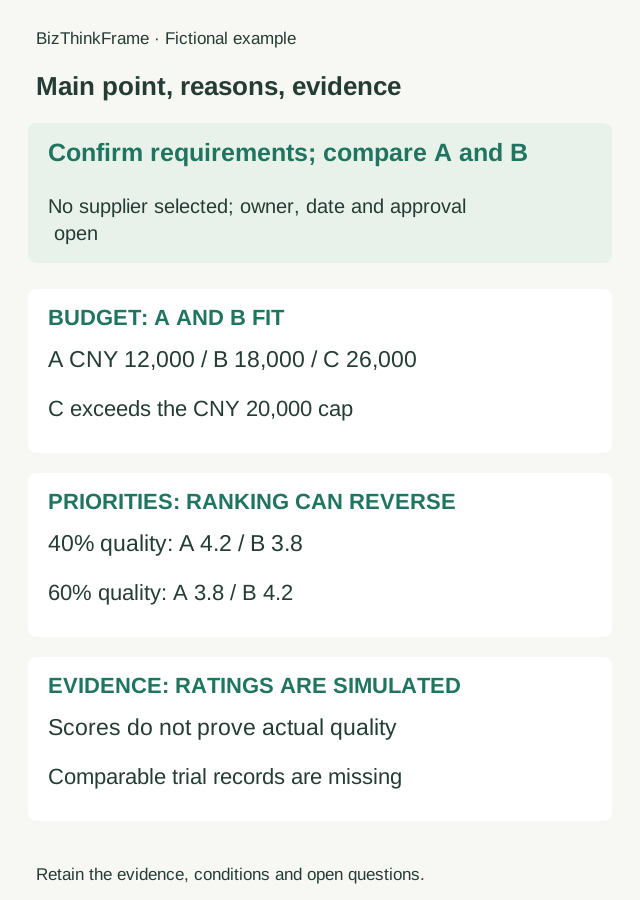
At 50% quality weight, A and B both score 4.0. Speed and cost share the remaining weight equally, with scores unchanged. The reversal point belongs to these assumptions, not a universal quality threshold. See the weight-sensitivity example for the calculation.
Check the links within and between groups
Read upward: prices support the budget judgment; weight scenarios support the need to clarify priorities; simulated ratings support the need for trials. If the material supports only a narrower judgment, narrow the main point rather than making the language more forceful.
Read across: budget addresses feasibility, weights address selection criteria, and trials address evidence. Do not count higher price and higher cost as two independent reasons. Within each group, keep material organized around the same question. A trial sequence may follow time order; an option comparison needs consistent dimensions.
The order should answer the reader's question. This proposal establishes feasible options, explains the trade-off, then requests evidence. If the audience first needs to know whether mandatory quality requirements pass, address that first. An unchecked result stays unknown.
A weak proposal would be:
Choose B: its quality is best, we held three review meetings, and C exceeds the budget.
Meeting counts do not establish quality. Excluding C does not establish B's advantage over A. Retain meeting records as supporting material, label the ratings as simulated, and rewrite the request around the checks still needed.
Make three specific changes: narrow “best quality” to a higher simulated quality rating in this exercise; retain the three meetings as a process record; replace “choose B” with a request to confirm mandatory requirements and obtain comparable trial evidence. This changes the scope of the request itself. Clearer structure still leaves you to check complete prices, credible ratings, and authority to accept the trade-off.
Choose between Minto, BLUF, and PREP
| Your current difficulty | Useful next content | Check to retain |
|---|---|---|
| Several groups of material must support one proposal | This Minto grouping exercise | Unsupported claims, duplicate reasons, and missing evidence |
| A request needs to be easy to find at the start of an email | BLUF work email | Conditions and approval status |
| One short passage needs a point and an explanation | PREP communication | Whether the example supports the point and repetition helps |
Combine them when useful; they are not three mandatory stages. Complex reasoning, long reports and different types of evidence need further work.
Build a proposal from your own material
Write the reader's question and the main point your material currently supports. Separate facts, calculations, judgments, and unknowns. Group related evidence and check each link: evidence to reason, reason to main point. Missing evidence becomes a checking task, not an invented number.
Explore three connections in the case, then paste your own complete proposal. Select the main point, a reason, and its evidence to retain the original passages and their relationship. Put uncertain inferences in the review notes. A reason without evidence can remain an open check; do not invent support just to complete a connection. More connections do not establish a stronger argument.
Connect the proposal to specific evidence
Explore three connections in the fictional supplier material, then try your own proposal.
- Supported main point
- Compare A and B within the current budget.
- Reason
- C exceeds the current budget cap.
- Supporting material
- Cap: CNY 20,000; A: 12,000, B: 18,000, C: 26,000.
- Where the inference stops
- Excluding C does not establish B's advantage over A or verify the quality requirements.
Paste the full proposal and connect its passages
Select a main point, one reason, then its evidence in the original. A reason can have several evidence links, up to 30 connections. Editing the original clears selections and links while retaining notes; download first to keep the current connections.
Main point: Not selected
Reason: Not selected
Review the complete record
Personal proposal and evidence links; connections are selected by you, not validated by this site

Full original:

Reader’s question:
Main point the material currently supports:
Reason groups and their shared question:
Facts, calculations, judgments, and unknowns in each group:
Links from evidence to reason and main point:
Counterexamples, gaps, and evidence needed:
Request, owner, deadline, and approval status:

Current main point:

Not selected

Current reason:

Not selected

Recorded connections:


Review notes and evidence gaps:


Raw selection record:


Narrow the claim or plan a check when support is missing. The number of links does not measure argument quality.
Personal material is saved separately by language in this browser. It is not uploaded or translated. Clearing site data deletes it; keep a downloaded copy and avoid editing it in multiple tabs. Review checks reset after changes.
The practice pack retains the fictional prices, weight scenarios, and blank outline. The case supplies no trial owner, deadline, or approval; use actual agreements. To organize a further request and open questions, use the work-update tool with your actual material.
Practice materials
- Fictional supplier inputs, calculations, and open checksJSON · 2 KB
- Blank argument grouping outlineTXT · 1 KB