
A one-page decision brief: what needs a decision now
Distinguish requirements, trial and purchase requests. Inspect the main brief and supporting detail using the same supplier material, retaining gates, evidence gaps and pending approval.
On this page
State the decision you need, then retain the evidence, tradeoffs, and unknowns needed to understand the options. Remove repeated background and put supporting detail where the reader can check it. One page is a reading goal for the main brief. Complex material may need attachments; keep conditions and readable type rather than forcing a page count.
This exercise turns a supplier comparison into a request, an options table, and an evidence checklist. The BLUF email example addresses where the opening appears. Here the question is whether the reader can see feasible alternatives, the conditions behind a recommendation, and what remains undecided.
Confirming requirements, authorizing a trial and deciding to purchase need different material and authority. Explore the request comparisons below, keep decision-changing limits visible in the main brief, then return to your own record.
Start with the comparison record
Original fictional teaching material: the budget cap is CNY 20,000. A costs CNY 12,000, B 18,000, and C 26,000. Quality, speed, and cost have simulated ratings from 1 to 5, with higher scores better. There are no actual trial records, no selected supplier, and no confirmed owner, deadline, or approval.
| Option | Price (CNY) | Quality / speed / cost ratings | Treatment in this comparison |
|---|---|---|---|
| A | 12,000 | 3 / 5 / 5 | Within budget; retain |
| B | 18,000 | 5 / 3 / 3 | Within budget; retain |
| C | 26,000 | 5 / 5 / 1 | Over budget; exclude |
In the fictional criteria, quality 3 means mandatory functions pass with revisions; 5 means mandatory functions and extensions pass. Speed 5 means the desired delivery point is met; 3 means the final point is met but the desired one is missed. Actual dates, requirements, and test records are absent. The ratings do not replace that evidence.
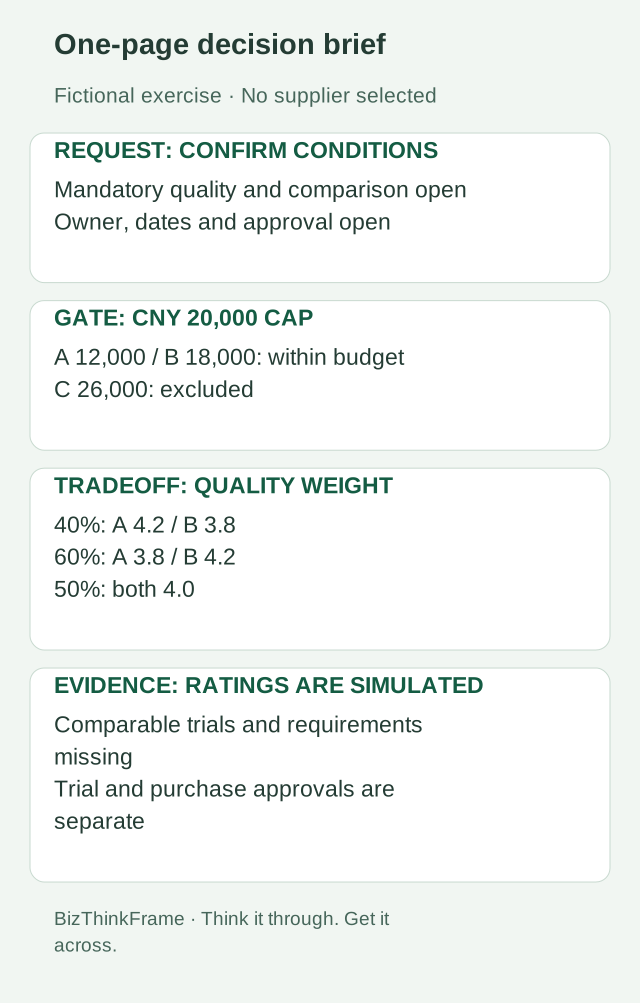
With quality/speed/cost weights of 40% / 30% / 30%, A scores 4.2 and B 3.8. At 60% / 20% / 20%, A scores 3.8 and B 4.2. At 50% / 25% / 25%, both score 4.0. These calculations assume the simulated ratings remain fixed. The material supports confirming requirements and comparison evidence; it does not establish that A is better.
A main brief you can inspect
Subject: Confirm quality requirements and comparison arrangements; supplier choice remains open
Request. Please confirm the mandatory quality requirements and whether to arrange comparable trials of A and B. The authorized owner, response date, trial effort, and approval remain open. This brief does not yet recommend buying from either supplier.
Current comparison. Against a CNY 20,000 cap, A at CNY 12,000 and B at CNY 18,000 fit; C at CNY 26,000 is excluded. With simulated ratings, A leads at 40% quality weight, B at 60%, and they tie at 50%. The ranking depends on priorities and ratings that have not been verified.
Evidence needed before selection. Confirm mandatory quality conditions. Compare A and B using the same requirements, observation method, and delivery points. Retain failures, revision costs, and record locations before updating the comparison. Simulated scores do not establish actual quality.
Response needed. Confirm the requirements, comparison arrangements, owner, and dates, or identify what remains open. Authorizing a trial and purchasing from a supplier are separate decisions.
This brief does not force a supplier recommendation. If your own evidence supports one, state the recommendation, accepted tradeoffs, contrary evidence, and action needing approval. If a decision is required immediately, make the available evidence and gaps explicit so the authorized person can confirm the risk being accepted.
Separate the brief from its supporting material
| Location | Test | Example |
|---|---|---|
| Main brief | Changes the meaning of the request, options, or risk | Budget gate, ranking reversal, no actual trial, pending request |
| Attachment or evidence record | Enables checking or follow-up | Rating criteria, weight calculations, actual trials when available |
| Remove from the brief | Repeats material without changing the judgment | Discussion chronology, repeated prices |
Removing detail from the brief does not mean deleting original records. Follow the team's retention agreements. Real evidence links must work; this exercise supplies no internal document and invents no attachment link. Hiding a risk in an attachment while calling the option verified in the brief still misleads.
Choose the request; keep its conditions visible
These are wording comparisons using the fictional supplier material above. Switching the request does not change what is known, establish authority or approve an action.
Confirm requirements
Please confirm the mandatory quality requirements and the basis for comparing A and B. Supplier choice remains open.
Prepare mandatory functions, acceptable revisions and delivery conditions. Actual requirements and dates are absent here; the owner, response date and authority remain open.
Main brief and supporting detail
Keep visible in the main brief
The CNY 20,000 cap retains A at 12,000 and B at 18,000; C at 26,000 is excluded.
Why keep this distinction? Keep the feasibility boundary visible in the main brief; quotes support checking. A budget hidden in an attachment can make C appear feasible.
A name in an attachment list is not evidence. Keep working source records, put decision-changing conditions in the main brief, and check actual links before sharing.
Open option comparison, then use your record to preview a decision requestThe existing transfer retains the decision original, previous reports and a full source copy. Review the material and request before confirming; the example switches above do not enter your draft.
Make one from your own record
Check the decision, authority, feasible options, evidence, and conditions before drafting the opening. Use the outline below or the downloadable practice pack. Mark missing material as pending rather than inventing dates to finish a template.
If the comparison is unfinished, use the decision matrix and sensitivity example to check gates and rankings. With your own decision record, review and confirm the preview in the option comparison tool to create a decision-request outline. The original record, existing reports and a full source copy are retained. Finish the layout in your actual format and check the brief against its attachments before sharing.
Start with a useful outline
Practice materials
- Blank outline, fictional statement and practice checksTXT · 2 KB
- Fictional supplier comparison, weight scenarios and unknownsJSON · 2 KB