
How to request support with clear effort and alternatives
Reconcile existing effort, the additional request, and the total; compare feasible alternatives and prepare a complete request with checks, stopping conditions, and approval status.
On this page
When you need support, make the decision clear: how much additional effort you request, what it enables, what is already allocated, which alternatives remain feasible, and how you will check whether a pilot is worth continuing. A bounded request gives the recipient more to discuss than “we need more people.”
This article places a two-person-day support request within six total person-days and separates effort from a two-week calendar window. Explore three fictional alternatives, then paste your own effort breakdown and complete request. Check totals, acceptance conditions, stopping rules, and unresolved items before taking the record into your work. Wording and arithmetic do not grant approval.
Establish the basis for the request
Original fictional exercise: a service team reviews 60 completed intake records from the previous week. Fifteen required additional information. The team wants to investigate form instructions and exception handling. The 25% share describes this batch, not all work, and does not prove the form is the sole cause. A new pilot has not been approved or run.
The proposed request is two person-days of testing and review support within a two-week window, alongside four person-days of the requester's own effort. Support staff, dates and the approving authority remain unconfirmed.
Fifteen out of sixty supports investigating the records. It does not establish that extra staff will eliminate the issue or that time has already been saved. Separate evidence, proposed explanations and expected effects.
Reconcile the total and the additional request
| Source | Proposed effort | Use and status |
|---|---|---|
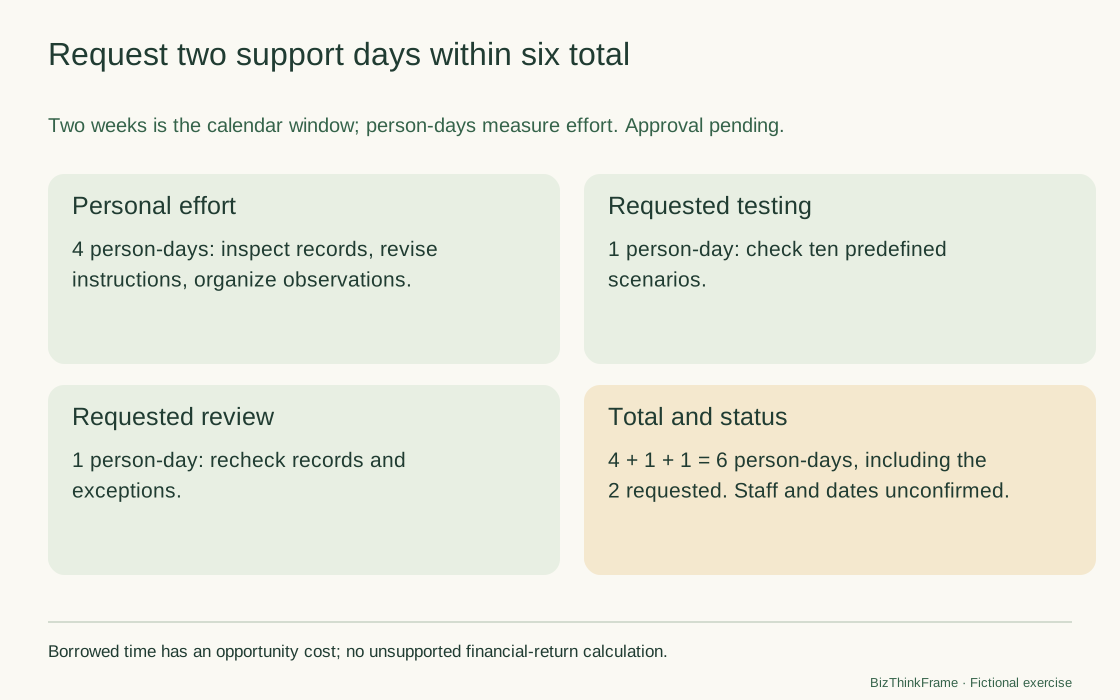
| Requester's existing work allocation | 4 person-days | Review records, revise instructions and organize observations; allocation needs confirmation |
| Requested testing support | 1 person-day | Inspect fields and exceptions using ten predefined test scenarios |
| Requested review support | 1 person-day | Recheck records and exceptions, then prepare a next-step recommendation |
| Total | 6 person-days | Includes the two requested days; they are not added again |
Two weeks is a calendar window. Six person-days is an effort cap. Borrowing a colleague's time has an opportunity cost, even without new cash spending. This example has no wage, market-price or revenue data, so it does not calculate financial returns.
Offer alternatives that are genuinely different
| Option | What it enables | Tradeoff or open question |
|---|---|---|
| Keep the current form and inspect records first | Learn where additional information is requested | No form change; confirm an owner and effort for the inspection |
| Reprioritize within current capacity | Defer a lower-priority task to release two person-days | Changes the other deadline and needs the appropriate authority |
| Request two support days for a two-week pilot | Combine four personal days with two support days, capped at six | Support and scheduling need approval; effects are unmeasured |
Do not make alternatives artificially weak. Keeping an existing approach may be reasonable when it meets the need. If support is unavailable, gathering evidence or narrowing scope may be appropriate.
This example does not score the options because cost and effect evidence remain incomplete. If you later have comparable options, hard limits and defined criteria, use the decision-matrix tool. Scores do not approve resources.
Inspect the output and the effect separately
| Check | Proposed approach |
|---|---|
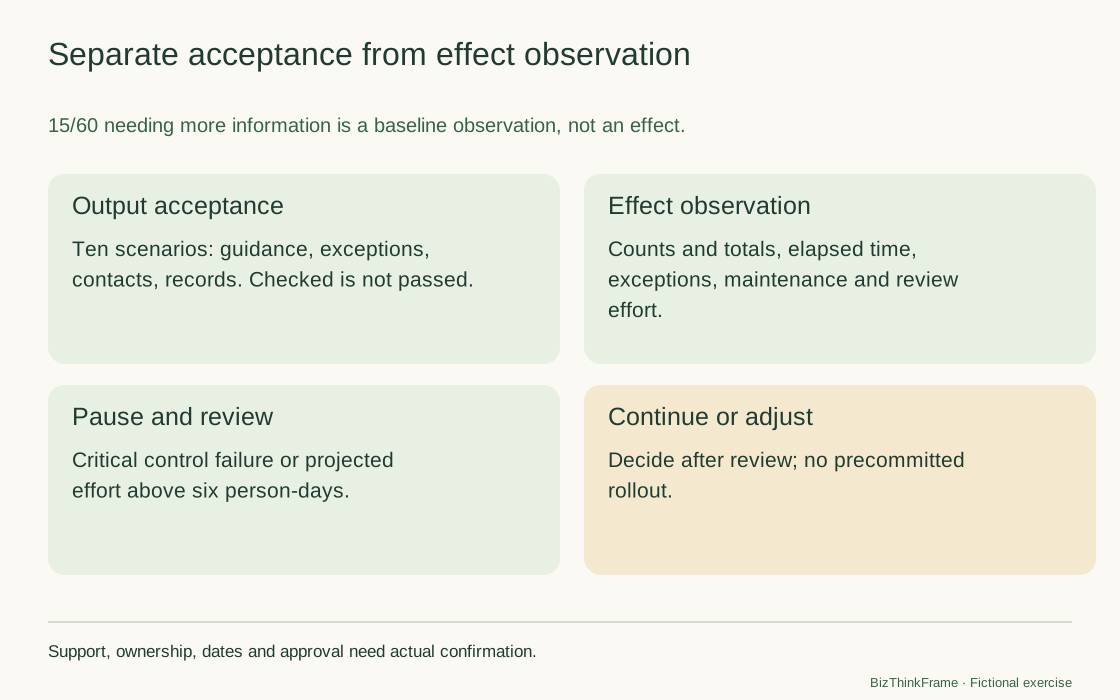
| Output acceptance | For ten predefined scenarios, inspect required-field guidance, exception routes, responsible contacts and retention of source records; retain critical controls |
| Effect observation | Record requests requiring more information and total requests, elapsed time, exceptions, maintenance and review effort; agree definitions and the window before starting |
| Continue or adjust | Use acceptance, actual effort and request composition; do not precommit to wider rollout |
| Pause condition | Pause and reconsider if a critical control fails or projected total effort exceeds six person-days |
“Ten scenarios were checked” describes activity; passing requires the results. “The form was revised” describes an output; fewer information requests require later observation. A small two-week before-and-after sample does not independently establish causality.
Reconcile effort, then clarify the request
Explore the three fictional alternatives. Switching explains their differences; it does not choose an option or overwrite your request below.
Request support for a pilot
Own effort 4 + testing 1 + review 1 = 6 person-days, including 2 requested days. Two weeks is a calendar window. Support and the pilot await approval; effects have not been measured.
Check the costs of inspection, reprioritization, and additional support separately. There is no approval or pilot result yet.
Review the complete record
Article's fictional alternative; not a personal request or approved decision

Request support for a pilot

Own effort 4 + testing 1 + review 1 = 6 person-days, including 2 requested days. Two weeks is a calendar window. Support and the pilot await approval; effects have not been measured.

The original 15/60 describes additional-information requests among completed records; it does not prove the form is the sole cause.
Paste your effort table and original request
Use three columns: own/request, item, person-days. Tabs or commas and up to two decimal places are accepted. Existing effort means allocations to this task, not the team's full capacity. Complete unknown values instead of treating them as zero.
Review the complete record
Personal resource request; material and estimates have not been verified by this site

Original effort table (source, item, person-days):


Effort table checks failed; no valid totals are available.

Paste 1–40 effort rows, at most 20,000 characters in total.

Full original request:

Recipient, authority and decision needed:
Problem, denominator, period and source evidence:
Evidence for explanations and expectations:
Own effort, requested effort and total:
Alternatives and opportunity cost:
Output acceptance and effect observation:
Stopping conditions and effort cap:
Support, response and review dates and times:
Actual approval, implementation and result status:

Review items checked by you, not approval: 0/3

The request is included in the total; do not add it again. Person-days measure effort, not calendar days or confirmed staffing. Approval depends on the actual response. Retain unknowns and alternatives from the original request.
Personal material is saved separately by language in this browser. It is not uploaded or translated. Clearing site data deletes it; keep a downloaded copy and avoid editing it in multiple tabs. Review checks reset after changes.
Make the request answerable
Please consider a two-week pilot with two person-days of support. Of 60 completed intake records reviewed from last week, 15 required additional information; the causes remain open. I propose four personal days plus one testing day and one review day, capped at six total. Alternatives are inspecting records without changing the form or reprioritizing other work. Check guidance, exceptions, contacts and record retention across ten scenarios, then observe information requests, elapsed time and added effort. Pause if a critical control fails or projected effort exceeds the cap. Please confirm whether to proceed, who can support it, dates and a follow-up point. None is approved yet.
Before sending, specify the recipient and an actual response date and time. Leave an unagreed owner or deadline open instead of inventing a commitment. Use the BLUF email case for the opening or the Minto proposal case to check the connection between reasons and the main claim.
Download the resource-request practice pack, add your own evidence, effort, alternatives and stopping conditions, then arrange them manually in the decision-request work-update mode. Check the approval status before sharing; sending a request does not mean it has been approved.
The effort table sums only the numbers you supply explicitly; it does not infer hours, staffing, or dates from prose. For AI-assisted organization, retain original facts, existing allocations, alternatives, and approval status. Review against actual agreements; generated support commitments are not real responses.