
A one-minute update: what to say and what to keep for questions
Compare edits of the same configuration material, retain requests and conditions, then rehearse aloud and compare two completed scripts with revision notes.
On this page
A short work update should explain the current position and what you need from the audience, supported by the most relevant facts. Keep other details available for questions. The result is a short outline plus a supporting evidence list, rather than a shorter version of every note you have.
One minute is a rehearsal target. Timing depends on pace, pauses, and questions; a word count cannot guarantee it. Select the information, say the update aloud, and keep conditions that affect the judgment.
Start with one set of material
Fictional teaching example: a team is preparing a configuration demo. Eight units in this week's plan were due by the agreed check-in; six are complete. The quantities, agreements, and times are invented for this exercise. Today, tomorrow, and Friday are relative times in the exercise.
| Material | Current position |
|---|---|
| Overall work | 12 configuration units |
| This week's plan and result | Eight planned; six complete |
| Unfinished units | Two integration units await interface information |
| Support needed | Ask the project lead to confirm the interface contact by 17:00 today |
| Next update | Check information availability and update at 12:00 tomorrow |
| Conditional alternative | If information is still missing, propose a six-unit Friday demo and arrange the rest separately |
| Open questions | Full causes of the deviation and exact demo impact; any scope change needs approval |
Six out of twelve is not completion against this week's plan: that denominator is eight. Two units waiting for information do not establish a sole cause for every deviation.
Organize the main update around the response needed
One outline to rehearse is:
Six of the eight configuration units planned this week are complete. Two integration units await interface information. The Friday demo scope may be affected; the exact impact remains unconfirmed. Please confirm the interface contact by 17:00 today. I will update the information status at 12:00 tomorrow. If it is still missing, I will propose a six-unit demo; that scope change needs your approval.
The outline retains progress, evidence, risk, a request, and an update time. It does not claim that a smaller demo is approved or that the full causes are known. If the audience only needs a progress update, lead with the position and next update. If the purpose is a scope decision, bring that decision request forward.
“We held lots of meetings and kept pushing, but there are interface issues” leaves the listener to work out the size of the deviation and the action needed. Clearer organization helps explain the situation; it does not guarantee agreement.
Put information in three places
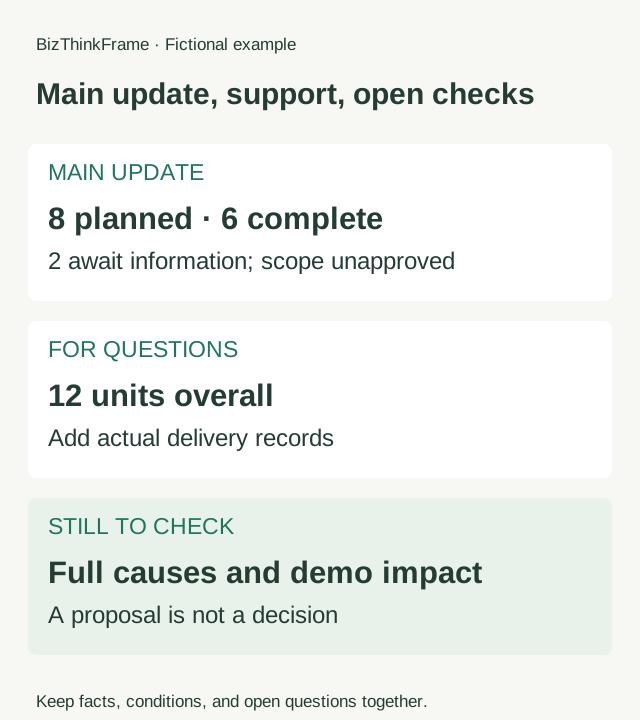
| Information | Placement and reason |
|---|---|
| Eight planned, six complete, two awaiting information | Main update: supports the progress judgment |
| Contact request and response deadline | Main update: the action this conversation needs |
| Unconfirmed demo impact and pending scope approval | Main update: removing these changes the meaning |
| 12 units overall | Supporting material: useful when discussing overall progress |
| Configuration and integration records | Supporting material: add actual record locations when using the outline |
| Full causes and information arrival time | Open questions: do not present them as known |
These placements depend on the purpose. Overall progress, a specific risk, and a decision request may require different main updates. First ask whether removing a detail would change the judgment; then whether you can explain it when asked.
Answer questions with evidence or a clear next check
If asked whether all remaining work is blocked, say: “Two units in this week's plan are known to be waiting for interface information. We need the item-level record to describe all 12 units. The full causes are still being checked.” Do not extend a local observation to all the work.
If asked whether only six units will be demonstrated, say: “That is a proposal if information is still missing at 12:00 tomorrow. It is not approved. I will update the position before requesting a scope decision.”
If asked what proves the six units are complete, point to delivery or acceptance records in your actual work. This exercise supplies no such records. Do not invent a test pass rate, customer response, or completed acceptance.
Rehearse with your own material
Write the audience, purpose, and specific response needed. Divide the material into the main update, support for questions, and open checks. Read the update aloud and time it yourself. Note pauses and questions, then trim details that do not change the judgment. Retain risks, conditions, and approval status.
Use the rehearsal timer below to read the script aloud and note the time and possible edits. After finishing, select two attempts to inspect their scripts, supporting material and measured times side by side, and note why you revised. Purposes and targets may differ; shorter does not establish quality. The comparison saves full copies without changing the completed originals.
What changes when you cut a sentence?
Compare edits of the fictional configuration case. The facts stay fixed; select an edit to inspect what the listener could lose.
Keep the conditions
Six of eight configuration units planned this week are complete. Two await interface information. The Friday demo scope may be affected; the exact impact is open. Please confirm the interface contact by 17:00 today. I will update the information status at 12:00 tomorrow. If it is still missing, I will propose a six-unit demo; that scope change needs approval.
This retains the weekly denominator, risk, request, update time and conditional proposal. The overall total of 12 can support questions; bring it into the main update if overall progress is the purpose.
Keep evidence for likely questions and mark unknowns as unknown. After revising your own script, speak it aloud; a word count cannot establish its duration.
Say the update aloud and time it
Write your script, start the timer and speak aloud. Finish to record the time; pauses are excluded. No audio is recorded, and timing does not assess content quality.
Compare two measured attempts before revising
Choose two completed attempts to retain copies of their scripts, supporting material and timing. Check purpose and target first, then whether edits retained evidence, risks, conditions and the request. Shorter does not mean better.
Complete an attempt to make it available here.
Complete an attempt to make it available here.
Review your notes after changing a selection. Comparison copies are saved separately; they remain available and export with the complete rehearsal record even after leaving the last ten attempts.
View complete rehearsal record
Manual work-update rehearsal
Measured elapsed time; pauses excluded. No recording, recognition, or content score.
Current target (seconds): 60

Current main update


Supporting material and open questions


Revision and checking notes


Two-attempt comparison (separately saved copies)

Comparison script 1
Not selected or unreadable copy
Full raw copy:

Comparison script 2
Not selected or unreadable copy
Full raw copy:

Reasons for revision and review notes


A time change does not establish completeness or persuasion. Attempts with different purposes or targets cannot be judged by time alone.
Text and the last ten completed attempts stay in this browser, separately for each language; switching language does not translate your text. The article and tool share the same-language record, so avoid editing it in multiple tabs. Unfinished timing is lost on reload.
PREP can structure a short point with a reason, example, and restatement. It does not replace fact checking, understanding the audience, or handling a delay. A progress update does not always need four PREP sections.
Download the outline or organize your own inputs in the work-update tool. Enter your own material, then use the timer above to check the actual speaking time.
For a known deviation with incomplete causes, read how to report a project delay and make a clear request. To clarify the purpose first, use the update preparation card.
Start with a useful outline
Practice materials
- Fictional configuration facts and open questionsJSON · 1 KB
- Blank reporting outlineTXT · 1 KB