
How to report a project delay and make a clear request
Compare an agreement with the deviation, separate known and possible impacts from proposed causes, and retain requests, update times, and unapproved alternatives.
On this page
When you discover a deviation, compare the current position with the original agreement. Separate known impacts, possible impacts, and proposed explanations. Then make a specific request and name the next update time. You can report known risks before every cause has been established.
This exercise produces a delay update someone can respond to. It does not guarantee persuasion or resolve the project. Follow your actual agreements about escalation, audience, and communication channels.
Start with an update you can use
Fictional teaching example: a configuration demo involves 12 units. Eight units in this week's plan were due by the agreed check-in; six are complete. Two integration units await interface information. Incomplete work alone does not establish a delay without that time comparison. Today, tomorrow, and Friday are relative times. This is separate from the supplier and service examples elsewhere on the site.
A vague update might read: “The interface information has not arrived, so we may be delayed. Please help coordinate.” It omits the agreed checkpoint, the affected scope, and the specific response needed.
Six of the eight configuration units planned this week are complete. Two integration units await interface information. The Friday demo scope may be affected; the exact impact remains unconfirmed. Please confirm the interface contact by 17:00 today. I will check availability and update at 12:00 tomorrow. If information is still missing, I propose demonstrating the six completed units on Friday and arranging the rest separately. That scope change needs your approval.
You do not need all causes resolved and a complete solution before communicating. A known deviation, a request for missing support, and a next update can form an honest current report. An urgent risk may require earlier escalation under your actual agreements; do not mechanically wait for this exercise's times.
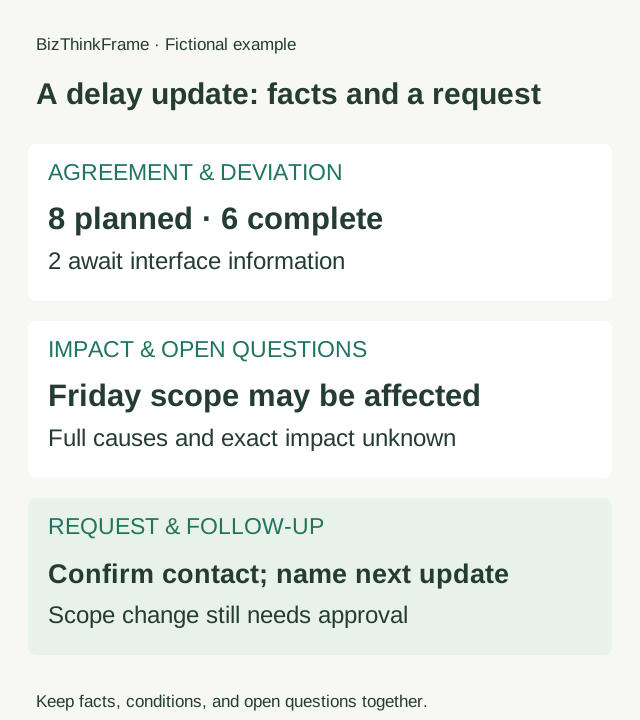
A deviation, an impact, and a cause are different
| Information | What it supports | What it does not establish |
|---|---|---|
| Six of eight planned units complete | A two-unit deviation from this week's plan | All 12 units are delayed |
| Two units await information | A known dependency | The interface team caused every delay; our team has no responsibility |
| A Friday demo is planned | The scope may be affected and needs checking | The demo will definitely fail or remain unaffected |
| A six-unit demo can be proposed | A conditional alternative | The scope change is approved |
Numbers, dependencies, and dates bound the problem. They do not supply a complete causal explanation. State what you are checking rather than fill an unknown with a plausible story.
Make the response needed specific
“Please support this” or “Please coordinate soon” does not specify an action. Here, confirming a contact by 17:00 is separate from approving a demo scope. Do not combine decisions with different owners or authority into one vague request for agreement.
| Request element | In this exercise |
|---|---|
| Action | Confirm the interface contact |
| Reason | Two integration units await information and need coordination |
| Response deadline | 17:00 today |
| Next update | Check information and update at 12:00 tomorrow |
| Conditional alternative | Propose a six-unit Friday demo if information remains missing |
| Approval status | Scope change unconfirmed; no response to the contact request yet |
Add real dates, an owner, and record locations when adapting the outline. A field named “owner” is not a reason to invent an assignment. Explain the expected output and dependencies of a resource request; an expected result is not an achieved benefit.
Review your delay update as a whole
Paste an existing draft or adapt the outline below. Review each point, then copy the complete text into your communication channel.
This draft is saved separately in this browser, with separate English and Chinese drafts. Clearing site data deletes it. Keep a copy and avoid editing in multiple tabs at once. Checks apply to this review only; review again after changing the text.
Prepare for questions and disagreement
If asked why the issue was not reported earlier, refer to the actual discovery time and communication agreement. This exercise does not supply a discovery timestamp, so do not invent a previous notification.
If told that every unit must be demonstrated on Friday, check feasibility rather than promise an unknown outcome. A response could be: “I will check the remaining units' information and timing requirements. I cannot currently guarantee completion. Please confirm the contact; I will submit the updated scope and dependencies at 12:00 tomorrow.”
If asked whether the interface team is solely responsible, state the known dependency and retain checks on internal planning, other blockers, and full causes. The report should support judgment and coordination rather than use a hypothesis to dismiss responsibility.
These are rehearsal situations, not predictions of a manager's response. Resolve factual differences against records. A person with the relevant authority must confirm a decision.
Follow up even if the problem remains open
At the agreed time, explain what changed, what remains unknown, whether a request received a response, and the next action. Silence is not approval. If a scope change is approved, record who approved it, when, and what changed. Otherwise retain its pending status.
Download the delay outline, or use the delay skill card for a quick review. The draft above accepts your complete text, so you can keep an existing update together as you revise it.
For a shorter spoken version, continue with what to include in a one-minute update. When the report includes changing rates, use percentage points and percent change to retain definitions and interpretation limits.
Use AI to review an existing draft
Give your existing draft and the records you can share to your usual AI assistant. Ask it to identify missing information before rewriting. Review the result against the records yourself.
Review this project-delay update using only the material I provide.
First list missing information about the original agreement, current deviation,
known and possible impacts, requested action, response deadline, and next update.
Keep proposed causes separate from confirmed facts. Retain approval status and
conditional alternatives. Do not invent an owner, date, promise, or approval.
Then suggest one complete update and explain the material changes.
My draft and supporting records:
[paste material]